The Voice of Mancini: Correspondence to H.W. Mesdag
Ref: RP-D-2020-22 | Rijksmuseum Archive (Donation 2020)
Transcription (French/Italianized)
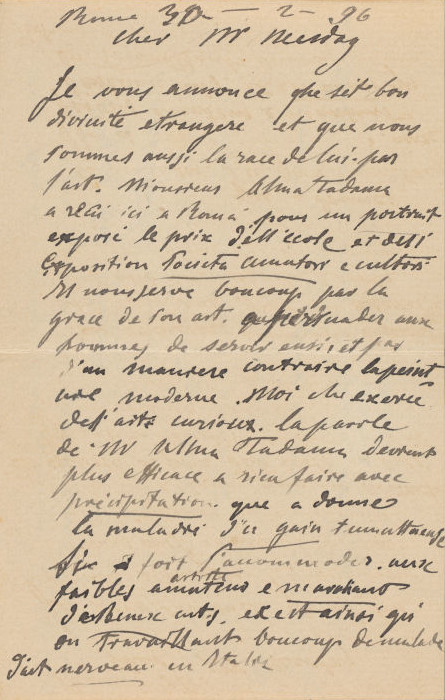
Roma 30—2—96. Cher Mr Mesdag.
Je vous annonce que sit bon d'unité etrangere et que nous sommes aussi la race de lui par l'art. Monsieur Alma Tadema a réussi ici a Roma pour un portrait exposé le prix de l'école et de l'Exposition Società Amatori e Cultori. Il nous serve beaucoup par la grace de son art, qu'a persuader aux hommes de servir aussi et pas d’un maniera contraire la peinture moderne.
Moi je exerce des fatti curieux. La parole de M. Alma Tadema devient plus efficace a rien faire avec précipitation que a donner la maladie d’un gain tumultueuse. Sic il fait s’accommoder aux faibles amateurs e marchands d'estimes arts, et est ainsi qu'en travaillant beaucoup de malades d'est cervello en Italie.
English Translation
Rome, Feb 30, 1896. Dear Mr. Mesdag.
I announce to you that it is good to have foreign unity and that we are also of his race through art. Mr. Alma-Tadema succeeded here in Rome with an exhibited portrait [winning] the prize of the school and of the Exhibition of the Society of Lovers and Cultivators. It serves us well, by the grace of his art, to persuade men to also serve—and not in a contrary manner—modern painting.
As for me, I am practicing curious things. The word of Mr. Alma-Tadema becomes more effective by doing nothing with haste than by giving the sickness of a tumultuous gain. Thus one must accommodate oneself to weak amateurs and merchants of esteemed arts, and it is so that by working much, many are sick of the brain in Italy.
Traduzione Italiana
Roma, 30-2-96. Caro Mr. Mesdag.
Vi comunico che è bene mantenere un'unità straniera e che anche noi apparteniamo alla sua stirpe attraverso l'arte. Il signor Alma-Tadema ha avuto successo qui a Roma con un ritratto esposto [vincendo] il premio della scuola e dell'Esposizione Società Amatori e Cultori. Ci serve molto, per la grazia della sua arte, persuadere gli uomini a servire anch'essi — e non in modo contrario — la pittura moderna.
Quanto a me, pratico fatti curiosi. La parola di Mr. Alma Tadema diventa più efficace nel non far nulla con fretta piuttosto che nel trasmettere la malattia di un guadagno tumultuoso. Così bisogna adattarsi ai deboli amatori e mercanti d'arte, ed è così che, lavorando molto, ci si ammala di cervello in Italia.
Academic Insights & Context
1. Linguistic Idiosyncrasy: Mancini's French is phonetic and "Italianized" (e.g., "d'est cervello" instead of "du cerveau"). This reflects his eccentric personality and lack of formal literary education, common among Italian Verismo painters of his background.
2. The "Sick of the Brain" Phrase: The closing remark "malades d'est cerveau" is deeply personal. Mancini suffered from severe mental health crises and was hospitalized in 1881. He often viewed his own intense creative process as a form of "illness" that his patrons, like Mesdag, helped him navigate.
3. Sir Lawrence Alma-Tadema: The mention of Alma-Tadema is crucial. It shows that Mancini was listening to the advice of more established, commercially successful artists. The advice to avoid "haste" and "tumultuous gain" suggests Mancini was struggling with the pressures of his Italian dealers.
4. The Patronage of Mesdag: H.W. Mesdag was not just a buyer; he was a lifeline. This letter shows Mancini reporting his Roman successes to his Dutch "guardian," reinforcing the bond that allowed Mancini to experiment with his radical "graticola" (grid) technique.
Postcard: Mancini to H.W. Mesdag regarding Alma-Tadema
Ref: RP-D-2020-22_01 | Rijksmuseum Archive
Transcription (French/Italianized)
[Side 1]
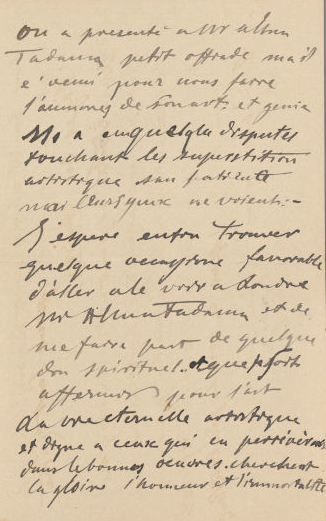
On a presenté a Mr alma Tadema petit offrade mail e' venu pour nous faire l'aumones de son art, et genie. Ma a eu quelque disputes touchant les superstition artistique san patiente mais leurs yeux ne voient. J'espère enfin trouver quelque occasione favorable d'aller ale voir a Londres Mr Alma Tadama et de me fare part de quelque don spirituel. et que je soit affermir pour l'art la vie eternelle artistique et digne a ceux qui in persévérant dans le bonnes oeuvres cherchent la gloire l'honneur e l'immortalità.
[Side 2]
les toute choses sont a nous. Le presente est de l'avenir; "pour l'art" (être sages du Christ).
Avec notre adjoint Mr Mesdag je cherchi mon vantaggio particolare mais je cherchi aussi celui de maitre pour vous informer de ma conscience afin que pas tout soient sauvés par la voie la plus excellente. Saluez et soit avec vous la pace de la santé et de l'art. Votre Ant. Mancini
English Translation
[Side 1]
A small offering was presented to Mr. Alma-Tadema, but he came to give us the alms of his art and genius. I have had some disputes concerning artistic superstitions without patience, but their eyes do not see. I hope finally to find some favorable occasion to go see Mr. Alma-Tadema in London and for him to share with me some spiritual gift, so that I may be strengthened for art—the eternal artistic life, worthy of those who, persevering in good works, seek glory, honor, and immortality.
[Side 2]
All things are ours. The present belongs to the future; "for art" (to be wise of Christ).
With our colleague Mr. Mesdag, I seek my personal advantage, but I also seek that of the master to inform you of my conscience so that not everyone may be saved by the most excellent way. Greetings, and may the peace of health and art be with you. Your Ant. Mancini
Traduzione Italiana
[Lato 1]
È stata presentata a Mr Alma-Tadema una piccola offerta, ma egli è venuto per farci l'elemosina della sua arte e del suo genio. Ho avuto qualche disputa riguardo alle superstizioni artistiche senza pazienza, ma i loro occhi non vedono. Spero infine di trovare qualche occasione favorevole per andare a trovarlo a Londra affinché egli possa spartire con me qualche dono spirituale, e io possa essere rinvigorito per l'arte: la vita eterna artistica, degna di coloro che, perseverando nelle buone opere, cercano la gloria, l'onore e l'immortalità.
[Lato 2]
Tutte le cose sono nostre. Il presente appartiene al futuro; "per l'art" (essere saggi di Cristo).
Con il nostro collega Mr. Mesdag, cerco il mio vantaggio personale, ma cerco anche quello del maestro per informarvi della mia coscienza affinché non tutti siano salvati per la via più eccellente. Saluti, e sia con voi la pace della salute e dell'arte. Vostro Ant. Mancini
Academic Insights & Context
1. Spiritual Ambition: This postcard reveals a more mystical side of Mancini. His desire for a "spiritual gift" from Alma-Tadema and his reference to "eternal artistic life" show that he viewed his work as a religious or spiritual calling, beyond mere technical exercise.
2. The Alma-Tadema Influence: Sir Lawrence Alma-Tadema was a significant figure for Mancini. While their styles were vastly different (Alma-Tadema’s meticulous neoclassicism vs. Mancini’s raw Verismo), Mancini clearly respected the elder artist's "genius" and sought his validation.
3. Linguistic Fusion: As with other Mancini documents, the language is a unique blend of French and Italian, reflecting his status as an international artist who never quite mastered the formal languages of the salons he frequented.
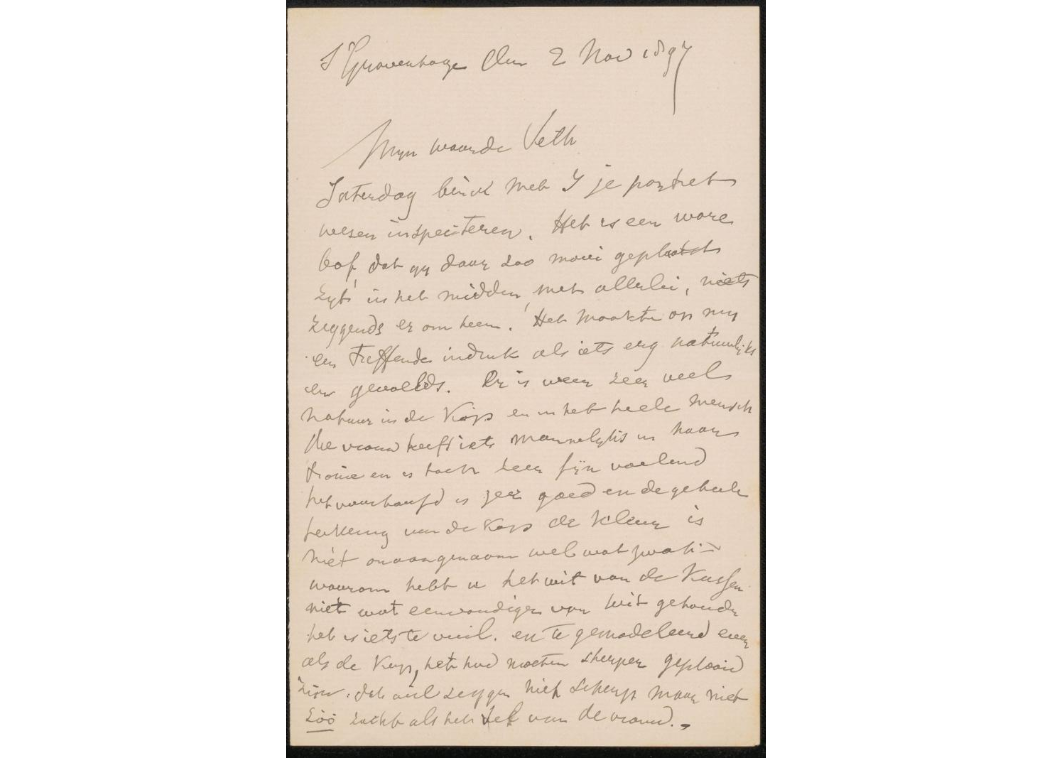
Correspondence: Jozef Israëls to Jan Veth (1897)
REF: RP-D-1984-40-J.ISRAELS-19 | DATE: November 2, 1897
Diplomatic Transcription (Dutch)
’s Gravenhage den 2 Nov 1897
Mijn waarde Veth,
Zaterdag ben ik met G je portret wezen inspecteren. Het is een ware bof dat gij daar zoo mooi geplaatst zijt in het midden met allerlei niets zeggends er om heen. Het maakte op mij een treffende indruk als iets erg natuurlijks en gewilds. Er is weer zeer veel natuur in de kop en in het heele menschelijke vrouw heeft iets mannelijks in haar kine en is toch heel fijn voelend het overhoofd is zeer goed en de gehele teekening van de kop de kleur is niet onaangenaam wel wat zwak— waarom hebt u het wit van de kussens niet wat eenvoudiger van wit gehouden het is iets te vuil, en te gemodelleerd even als de kop, het had moeten scherper geplooid zijn, dat wil zeggen niet scherp maar niet zóó zacht als het vleesch van de vrouw.
Scholarly Translation
The Hague, Nov 2, 1897
My dear Veth,
On Saturday, I went with G to inspect your portrait. It is a real stroke of luck that you are so beautifully placed there in the middle, with all sorts of insignificant things around it. It made a striking impression on me as something very natural and deliberate. There is again a great deal of "nature" in the head and in the whole human [figure]; the woman has something masculine in her chin and is yet very sensitive; the upper head is very good, as is the entire drawing of the head; the color is not unpleasant, though somewhat weak— why did you not keep the white of the cushions a bit simpler in their whiteness? It is a bit too "dirty," and too modeled, just like the head; it should have been more sharply folded—that is to say, not sharp, but not as soft as the flesh of the woman.
Traduzione Critica
L'Aia, 2 nov 1897
Mio caro Veth,
Sabato sono andato con G a ispezionare il tuo ritratto. È un vero colpo di fortuna che tu sia posizionato così bene lì nel mezzo, con ogni sorta di cose insignificanti intorno. Mi ha fatto una forte impressione come qualcosa di molto naturale e deliberato. C'è di nuovo molta "natura" nella testa e in tutta l'e[pressione] umana; la donna ha qualcosa di maschile nel mento ed è tuttavia molto sensibile; la parte superiore della testa è molto buona, così come l'intero disegno della testa; il colore non è sgradevole, sebbene alquanto debole— perché non hai mantenuto il bianco dei cuscini un po' più semplice nel loro candore? È un po' troppo "sporco" e troppo modellato, proprio come la testa; avrebbe dovuto essere piegato più nettamente—vale a dire, non tagliente, ma non così morbido come la carne della donna.
Contextual Significance
The Mancini Link: Zilcken kept this correspondence in his Mancini files because it established the aesthetic standards of the circle that ultimately championed Mancini's work. The discussion of "deliberate naturalness" mirrors the qualities Zilcken used to praise Mancini's revolutionary style.
Thérèse Schwartze to Philip Zilcken (1893)
Ref: RP-D-1982-43-SCHWARTZE(TH.)-7 | DATE: October 21, 1893
Transcription (Dutch)
Amst. 21 Oct. 93
Waarde Heer Zilcken,
Ik dank u wel voor de toezending van "’t Vaderland". Ik heb uw stuk met plezier 2 maal gelezen, mij dunkt het is uitstekend en ik dank u bijzonder voor de regelen waarin gij het nog eens voor de pastels opneemt. Het antwoord van E.G.O. is zóó flauw en kinderachtig, de man gaat achteruit.
Translation
Amsterdam, Oct 21, 1893
Dear Mr. Zilcken,
Thank you very much for sending "'t Vaderland." I read your piece twice with pleasure; it seems excellent to me, and I thank you especially for the lines in which you once again stand up for the pastels. The response from E.G.O. is so weak and childish; the man is declining.
Traduzione
Amsterdam, 21 ott. 1893
Caro signor Zilcken,
La ringrazio molto per l'invio de "'t Vaderland". Ho letto il suo pezzo due volte con piacere; mi sembra eccellente e la ringrazio particolarmente per le righe in cui prende ancora una volta le difese dei pastelli. La risposta di E.G.O. è così debole e infantile; l'uomo è in declino.
Historical Analysis
The "Pastel" Debate: At the time of this writing, Thérèse Schwartze was establishing herself as a premiere pastelist. While pastel was often dismissed as a "feminine" medium, Schwartze used it with a vigor that challenged contemporary hierarchies. Zilcken’s defense in the newspaper 't Vaderland served as critical validation of her technical mastery.
Postcard from Antonio Siviero (1912)
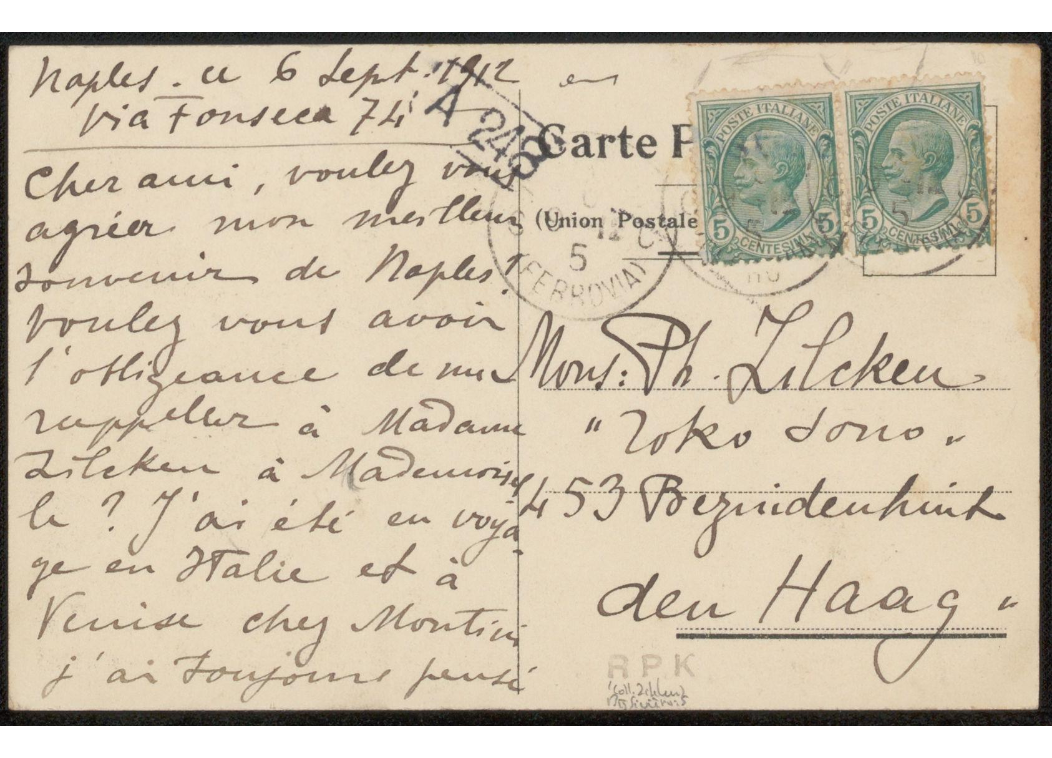
Ref: RP-D-1982-43-SIVIERO-5 | Naples, Sept 6, 1912
Transcription (French)
Naples. le 6 Sept. 1912
Via Fonseca 74
Cher ami, voulez vous agréer mon meilleur souvenir de Naples. Voulez vous avoir l’obligeance de me rappeler à Madame Zilcken à Mademoiselle ? J’ai été en voyage en Italie et à Venise chez Montini j’ai toujours pensé...
Translation
Naples, Sept 6, 1912
Dear friend, please accept my best regards from Naples. Would you be so kind as to remember me to Mrs. Zilcken and to Miss [Zilcken]? I have been traveling in Italy, and at Montini's in Venice, I was always thinking [of you]...
Traduzione
Napoli, 6 sett. 1912
Caro amico, voglia gradire i miei migliori ricordi da Napoli. Vorrebbe avere la cortesia di ricordarmi alla signora Zilcken e alla signorina? Sono stato in viaggio in Italia e a Venezia da Montini ho sempre pensato [a voi]...
Context
The Mancini Network: Antonio Siviero was a contemporary in Italy who maintained ties with Mancini’s Dutch patrons. This archival grouping underscores how these artists collaborated to challenge the academic art establishment of the late 19th century.
Biographical Note: Mancini via Mesdag (1903)
Ref: RP-D-2017-1004 | August 17, 1903
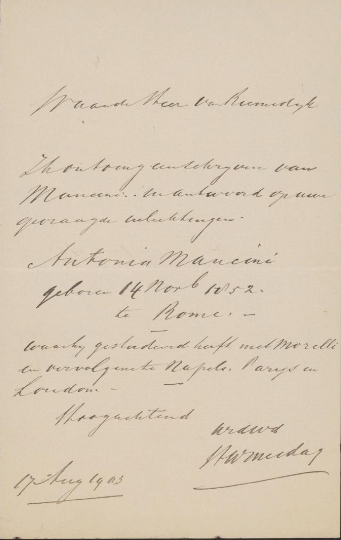
Transcription (Dutch)
Waarde Heer Van Riemsdijk
Ik ontvang een schrijven van
Mancini - in antwoord op uwe
gevraagde inlichtingen.
Antonio Mancini
geboren 14 Novbr 1852.
te Rome. -
waarbij gestudeerd heeft met Morelli
en vervolgens te Napels, Parijs en
Londen. -
Hoogachtend
uw dw d
HW Mesdag
English Translation
Dear Mr. Van Riemsdijk,
I have received a letter from Mancini - in response to the information you requested.
Antonio Mancini
born 14 Nov 1852.
in Rome. -
who studied with Morelli and subsequently in Naples, Paris and London. -
Respectfully,
your obedient servant,
H.W. Mesdag
Traduzione Italiana
Pregiato Signor Van Riemsdijk,
Ho ricevuto uno scritto da parte di Mancini, in risposta alle informazioni da Lei richieste.
Antonio Mancini,
nato il 14 novembre 1852
a Roma. -
Il quale ha studiato con Morelli e successivamente a Napoli, Parigi e Londra. -
Con i miei più cordiali saluti,
il Suo devotissimo,
H.W. Mesdag
Contextual Insight
Standardizing the Legend: By 1903, Mancini's international reputation was firmly established. This note from H.W. Mesdag to Barthold van Riemsdijk (then director of the Rijksmuseum) serves as an official confirmation of Mancini's background, ensuring that the museum's records accurately reflected his training under Domenico Morelli and his cosmopolitan career trajectory.
-7.png)